Wednesday, September 10, 2025

Embossed Drambuie Bottle Edinburgh Scotland Brown Liquor Bottle.


This bottle is embossed on the heal: THE DRAMBUIE LIQUEUR CO. LTD.

                                                            EDINBURGH SCOTLAND. 

The FEDERAL LAW FORBIDS SALE OR RE-USE OF THIS BOTTLE message is on the shoulder, which puts the date between 1935 and 1964.


The concave bottom reads: BOTTLE MADE IN
                                          UNITED KINGDOM


There are also some numbers on the bottom.


Drambuie was first commercially produced in Union Street in Edinburgh in 1910. Only twelve cases were originally sold. In 1916, Drambuie became the first liqueur to be allowed in the cellars of the House of Lords and Drambuie began to ship worldwide to British Army officers' messes.

About 1940, the company moved to bonded premises in Dublin Street Lane where the liquor was compounded (the process of flavouring and sweetening the whisky spirit). The bottling plant was in the same lane while the company office was in York Place. After a short period at nearby Broughton Market, in 1955 the operation was moved to premises at the foot of Easter Road in Leith. Further expansion led to a move to purpose-built premises on the western edge of Kirlinsin 1959. These premises were vacated in 2001 and thereafter production was contracted out, in the first instance to the Glenmorangie bottling plant at Broxburn and, in 2010, to Morrison Bowmore Distillers.   Source: Wikipedia.


There is a lot of history to this liquor.  Skipping a few pages to get down to the bottom line, here is a bit of the story.


Skipping down to the end...


Here is a link to a much longer history.

History - The Drambuie Liqueur Company Ltd

Tuesday, September 9, 2025

Embossed Kerr Self Sealing and Kerr Mason Canning Jars.


Canning Jar Embossed:
KERR
SELF SEALING
TRADE MARK REG.
WIDE MOUTH MASON.


Kerr Mason Jar with AHK Mark on the Bottom.


"Businessman and entrepreneur Alexander Hewitt Kerr (September 4, 1862 – February 9, 1925) organized this company in Portland, Oregon in 1903 under the name Hermetic Fruit Jar Company.  The official name was changed in 1904 to Kerr Glass Manufacturing Company.  Kerr did not actually manufacture glass during the earliest years but was, more accurately, a sales company/distributor during the period from 1904 to 1909 and had jars made for them (with the Kerr name embossing) by other glass companies.

The first jars made for Kerr were evidently the Kerr - Economy brand jars, and that type was made in the earliest years  (c.1903-1909) by Illinois-Pacific Glass Company of San Francisco, and also by the Hazel-Atlas Glass Company (based in Washington, PA and later at Wheeling WV) from 1906 to 1909.

On February 15, 1909, Kerr purchased the Altoona Co-Operative Glass Company of Altoona, Kansas (which had recently gone bankrupt) and within a month or so KERR brand fruit jars were being produced at that location"...

Here is a link that provides dates on the trade marks and bottle maker's marks.

KerrGlass.pdf

Here is another link on the company.

Kerr Glass Manufacturing Corporation - Maker of Fruit Jars (glassbottlemarks.com)

The most common canning jars I've found on the Treasure Coast are Ball, Presto and Kerr.  Also a couple others such as Tropical and Presto.


Embossed Parsons Ammonia Household Cleaner Bottle.


PARSONS' HOUSEHOLD CLEANSER Bottle.

Embossed: PARSON'S HOUSEHOLD CLEANSER.

Other found Pareson's bottles are embossed PARSON'S SUDSY AMMONIA.


Parsons Ammonia and Cleanser Bottles.


Parsons Household Ammonia dates back to 1881. That makes it one of the older consumer products in the United States. Today, it has a new life as a sister product to the Brillo pad.

The brand was originally a product of the Columbia Chemical Works of Brooklyn, with offices on Jay Street. Through the 20th Century, it was known on every grocery shelf across the country, and under most kitchen sinks.

Ammonia has a slew of uses. Today, it is mostly seen as something that is used in window cleaners, but it was seen as a laundry item in an earlier time...  


Source: Parsons the Classic American Ammonia | BrandlandUSA


Source of the ad:

1909 Ad Columbia Chemicals C. C. Paron's Ammonia Cleaner Rag Cleanser – Period Paper Historic Art LLC

Thursday, September 4, 2025

Small Ball Bottle. Embossed 2.5 OZ. 3.5 Inches Tall.


3.5 Inch Tall Ball Bottle.


This small bottle stopper type bottle is embossed on the neck. 2 1/2 OZ.

The bottle is 3.5 inches tall.

The Ball mark on the bottom would probably date to between 1933 and 1960 and I would believe made by the Ball Brothers Glass Manufacturing Company.

I don't know the product it held.  I would guess a product for canning or jelly/jam production.

Any additional information would be appreciated.

Wednesday, July 2, 2025

7/2/25 Report - 1920s H. J. Heinz Bottle by Owens Bottle Co.


Unusually Shaped Bottle Find.

I found this bottle and didn't know what it held.  I thought it looked like a food bottle or maybe oil.

The bottom of the bottle answered that question.  The bottom was embossed as follows.

H. J. Heinz CO.

211

3O in a square and 6

PATD

Here is the bottom.  You might not be able to see all of it clearly.


Here is a great link for Heinz bottle information.  Heinzbottlecodes.pdf

It shows that the O in a square was the mark of the Owens Bottle Co. (1911 - 1929)

Here is entry for the 211 code.

#211 held white, malt, cider or tarragon vinegar. It was in use between 1924 and 1943 to contain vinegar. Between 1924 and 1927 the container was sealed with and aluminum and cork device that required no threads in the sealing area. After 1927, it was sealed with and aluminum roll-on type closure that did require threads in the throat opening of the bottle. 

Not what I guessed.  The date of the code combined with the date of the Owens mark narrows the date down to between 1924 and 1929.

---

Friday, June 27, 2025

Cliquot Club Embossed Aqua Bottle Made by the F. E. Reed Glass Co.


Cliquot Club Bottle.

On the sholder the bottle is embossed as follows:

TRADE

CLIQUOT CLUB

MARK.

On the heel there is a big bold REGISTERED and a very small 84C or 84G.


And on the bottom is an R in a triangle.


Clicquot Club Ale—pronounced “Klee-ko”—has a fizzy legacy that dates back to the 1880s in Millis, Massachusetts. It all began when Charles LaCroix, of the LaCroix Fruit Farm, teamed up with Henry Millis to bottle sparkling cider under the name “Clicquot,” inspired by the French champagne Veuve Clicquot.

By the late 1880s, the company shifted focus from cider to ginger ale, which became its signature product. Henry Millis was a stickler for quality, using premium Jamaican ginger and Cuban cane sugar, which gave Clicquot Club Ginger Ale its standout flavor. The brand quickly gained popularity across New England and beyond.

In the early 20th century, under new ownership by Horace and H. Earle Kimball, Clicquot Club exploded in popularity thanks to savvy marketing. They introduced “Kleek-O the Eskimo Boy” as a mascot, lit up Times Square with a massive animated sign, and even sponsored a radio show called The Clicquot Club Eskimos.

At its peak, the company was one of the largest ginger ale producers in the world, with a factory so big it had its own train station. But by the 1960s, changing tastes and competition took their toll. Clicquot Club was sold to Cott Beverage Corporation in 1969 and eventually dissolved in 1980.

Soure: Clicquot Club – Bay Bottles

I also found one with an embossed Eskimo boy.  Maybe a can find that one and add it to this post.


The R in a triangle maker's mark indicates the F. E. Reed Glass Co.

For detailed information on that see FEReed.pdf.


As stated above Cliquot Club was inspired by a champagne.

For information about that, here is a link.

The Widow Who Created the Champagne Industry


Tuesday, June 24, 2025

Brown Embossed Spider, Web and Fly. Spiritus Frumenti. Spirit of Grain. Diamond Glass Company Bottle. Frankfort Distillery Whiskey Bottle.


Brown Bottle With Embossed Wheat and Spider and Web.

This is a whiskey bottle I think might be from the Frankfort (KY) Distillery


This bottle is extensively embossed with a spider web, fly and wheat.

From what I've found, it appears to be a Prohibition era medicinal whiskey bottle. Six distilleries were authorized during the prohibition to make medicinal alcohol. “Spiritus Frumenti” is Latin for “Spirit of the Grain,” which was a generic name for medicinal whiskey during the Prohibition. Spiritus Frumenti was produced by the George T. Stagg Distillery and some other distilleries throughout the 1920s creating many iterations of Spiritus Frumenti.

At first, I thought the diamond on the bottom of the bottle indicated the Diamond Glass Co., but there are some other possibilities.


Diamond Makers Mark on Bottom.


Diamond.pdf (sha.org) provides the following information and much more.

In 1904, the plant made “prescription, liquor and proprietary ware and milk jars” with the same equipment...

Although the Diamond Glass Co. of Royersford, Pennsylvania, was long-lived (1886 1990), its market area seems to have been mostly restricted to eastern Pennsylvania and the surrounding states. Its main manufacturer’s mark was a diamond embossed on bottle bases with some variation...


I found the picture (below) of a similar bottle with a different top and the label still attached.


Below is a closeup of that label.


If you can provide any additional detail, please do.

Friday, June 20, 2025

Brown Benedictine B and B embossed bottle.


Both Sides of Benedictine B and B bottle.


The bottle is embossed MARQUE DEPOSEE high on the shoulder.

Then BENEDTICTINE 

B AND B

It has a high kickup, which you can see therough the glass.

Marque deposee means registered trademark.

It isn't a very old bottle.  Obviously, machine made, but no glass maker's mark.

I haven't done much research but would take it to be mid-1900s, probably no earlier than 1937.

If you can correct that please do.

The liquor has a very old (1500s) and interesting history even though this particular bottle isn't very old.


From Bénédictine: History of French Herbal Liqueur & B&B which provides a long history

Monday, March 17, 2025

MILKETTE ACL Bottle. Yoo-Hoo of Florida Corporation. Miami, FL.


Below is a better view of the writing on the back.


I've done a little research on the Milkette bottle now and found out a few things.  On the bottom is the number 65 which I'm pretty sure is the date code.  So, it is 1965.

I haven't found a lot on this bottle.  I only found one similar bottle, which was on eBay and dated 1964.

The product is coconut milk.  I never would have guessed.


I did find mention of Yoo-Hoo offering a coconut flavor, but haven't otherwise found any more on the drink.

Yoo-hoo began introducing new flavors to its lineup in 1995, including chocolate-coconut, chocolate-mint, chocolate-banana, and chocolate-strawberry. Yoo-hoo's other flavors have included vanilla, strawberry, cookies & cream, chocolate peanut butter, and chocolate caramel. The Double Fudge, banana, and Island Coconut flavors were discontinued.


Tuesday, February 25, 2025

Return Money Back Deposit ACL Soda Bottles.


Here is one group of Money Back Return Deposit ACL bottles found on the Treasure Coast.  I'll be adding others to this post.  Some bottles will also be shown individually in other posts.  For example, SunKist is covered in post on that topic.

Here we have Mr.Pibb, Mountain Dew, Tab, 7-UP and SunKist bottles.  Some of these bottles may have an individual post in the future.

I'll add more ACLs here in the future and perhaps provide individual posts with more specific information on some bottles

Typically, soda bottles recovered from the wild are in poor conditions, often with little to no paint remaining.  Those shown above are pretty good.


Friday, January 17, 2025

J K & S. embossed light green Kilner Glass embossed food container bottle. Circa 1870 - 1900.


Light Green John Kilner and Sons Wide Mouth Bottle.

It was very difficult to photograph the embossing on the bottom of this bottle but it is embossed J K & S  in an arch and under that in an inverted arch is what appears to be 2684, supposedly the mold number.  The six, if that is what it is, has a very long straight vertical staff and an incomplete cirble.  It looks more like a long handled backwards J.

This bottle has some nice big bubbles.  I can't find any evidence of seams.  


Beginning with John Kilner in 1842, the Kilner family continued as owners and operators of glass plants at Yorkshire, England, for three generations. The senior Kilner brought his two oldest sons into the business in 1844, opening a plant at Wakefield – eventually bringing in the younger two sons as well. The firm purchased a factory at Thornhill Lees in 1847 and operated the two until John Kilner’s death in 1857. When the senior Kilner died, there was a break in the family. John Kilner, Jr., took over the Wakefield plant, bequeathing the firm to his son, Barron, probably in 1900. The remaining brothers formed Kilner Brothers at the Thornhill Lees factory, opening a new plant at Conisbro in 1863. Eventually, their sons took over the operation. Both groups eventually became limited partnerships (or corporations), operating until the late 1930s. Several types of Kilner bottles – mostly food containers – are fairly common in the U.S

... JK&S (1857-1900) Urquhart (1976:128) illustrated the only example of this logo that we have found – “JK&S (arch) / 1938 (inverted arch)” on a product jar (Figure 14). Note that the four-digit numbers on Kilner products often began with “17,” “18,” or “19” – but these were model or catalog numbers rather than date codes. This mark was probably Figure 13 – Codd bottle (eBay) used during the 1870-1900 period – although that should be taken as the “best guess.” A more conservative range would be 1857-1900


Here is the link for much more about Kilner and Kilner Brothers Glass.

KilnerGlass.pdf

Thursday, January 16, 2025

White Horse Whiskey Distillers Ltd. Glascow, Scotland. Brown Embossed Bottles with Painted White Horse.


You can see the White Horses on each bottle.  On the shoulder of both of these brown bottles is the embossed FEDERAL LAW FORBIDS SALE OR REUSE OF THIS BOTTLE, which means the bottle dates to between 1935 and 1964.

Bottoms of Both Bottles.


The bottoms are embossed with the name of the company as well as the location.

On Sir Peter Mackie’s death in 1924, the company went through a re-organisation and non-core activities such as the BBM (Bone, Blood & Muscle) flour operation were sold off and the company changed its name to White Horse Distillers Ltd., after its best known product. The company also closed the Hazelburn distillery, despite trying to rebrand the product as a Kintyre whisky to overcome the poor reputation of Campbeltown whiskies at the time.

In 1927 White Horse Distillers Ltd. was taken over by the Distillers Company Ltd (DCL) which, for a number of years, used it as a holding company and granted it the licence to a number of distilleries including Lagavulin and Glen Elgin.

DCL also withdrew White Horse blended whisky from its home market, concentrating on overseas sales, and, although the whisky itself is still produced, new owner Diageo dissolved White Horse Distillers Ltd. as a company in 2010...

Here is the link for more information about the White Horse Whiskey Distillers.

White Horse Distillers | Scotch Whisky


Friday, November 22, 2024

Quack Cure Bottle Embossed: McELREE'S CARDUI. THE CHATTANOOGA MEDICINE CO.


Bottle Embossed: THE CHATANOOGA MEDICINE CO


I haven't post any bottles for a while, but here is a Treasure Coast found light green bottle, embossed as shown below the photos.  It has a good story behind it.


Other Side of Same Bottle Embossed: McELREE'S CARDUI.


When the Civil War ended, two Federal soldiers, Z. C. Patten and T. H. Payne, were mustered out of the army in Chattanooga. They formed a partnership for selling paper, blankbooks and miscellaneous stationery supplies. Business in Chattanooga was in a disorderly state because of the chaos caused by the war, and the rapid surge forward of business reorganization...

Patten, however, gave rein to his expansive ideas and bought the formulas of Thedford’s Black Draught and McElree’s Wine of Cardui, and organized the Chattanooga Medicine Company for large-scale production of these medicines...

Of Wine of Cardui, a newspaper ad said, ‘This pure wine is a simple vegetable extract without intoxicating qualities, and has proved to be the most astonishing TONIC FOR WOMEN known to medical science.”

Twenty years later when Samuel Hopkins Adams published his “Great American Fraud” articles, he mentioned the advertising of the Chattanooga Medicine Company as not being suitable reading material for a family gathered around the breakfast table...

Here is a link to an article that provides a lot of additional information.


Black Draught and Wine of Cardui - Appalachian History

Below is an older bottle and box containing the Chattanooga Medicine Company tonic.


McElree introduced his Cardui in 1879 and sold this product to the Chattanooga Medicine Company in 1882, where it was originally marketed as "McElree's Cardui, The Woman's Tonic."” In the 1920s product, the ingredients were listed as: Blessed Thistle, Golden Seal, and 19% alcohol (38 proof). In the US in the 1800s & early 1900s, use of alcohol was viewed with disdain. Thus, the increasing popularity of an increasing number of alcohol based patent medicines was prevalent (McElree's Cardui Tonic; Reverend R.I. McElree; 1879; Fincham Collection 040 | eHive).

---

Wednesday, September 18, 2024

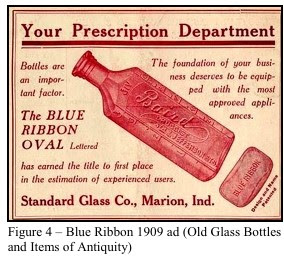
Blue Ribbon Graduated Pharmacy Bottle by Standard Glass Company, Marion, Indiana. Quality and Purity.


Graduated Pharmacy Bottle with Blue Ribbon in Small Block Letter on the Bottom.


This is a small (4 inches high) graduated pharmacy bottle made by Standard Glass Co.  The shoulder area on one side is embossed 3i on one side.  The three is actually a symbol meaning ounce.  It is a one oz. bottle.  It is four inches high.

On the other side "QUALITY" is embossed on the shoulder, and "PURITY" on the heel.  

On the bottom, in very small block letters is "BLUE RIBBON."

There are some nice bubbles in this blown bottle.  The brown tint is from staining.  The glass is clear.

The pharmacy would add their own paper label.

From sha.org...

 Toulouse (1971:87) dated the mark [BLUE RIBBON] as being used from 1920 to 1930. However, the patent and trade mark registration dates, as well as date ranges provide for individual bottles by the sources listed above and early advertisements, suggest that the bottles were used much earlier, almost certainly by 1908. Production almost certainly continued into the 1920s and may have extended until the company sold in 1932. For most firms, mouth-blown prescription bottles were discontinued by the mid- to late 1920s,...

Below is the link for more information.

StandardGlass.pdf (sha.org)


Thursday, August 22, 2024

PRESTO Canning Jars


PRESTO SUPREME MASON Jar with Top.

Maybe a couple months ago I did a post showing some Ball Mason jars and mentioned some of he other brands.  On the heal is embossed MFG. by Illinois Glass Works.

Unlike many, this jar has its metal top intact, as shown below.

Top of Same Presto Canning Jar.

 The Illinois Glass Co. merged with the Owens Bottle Co. in 1929 to create the massive Owens-Illinois Glass Co.  This jar was therefore manufactured prior to 1929. 


Three Other Presto Jars From the Treasure Coast.

The left most jar is embosssed PRESTO GLASS TOP and on the heal, Mfg. by Illinois Glass Works.

Center, PRESTO and on the heal Mfg. by Illinois Glass Works.

And right, PRESTO Superior Mason, and on the bottom (not the heal) OWENS ILLINOIS GLASS COMPANY.  So this one would presumably be from after 1929.

Here are a variety of jars produced by the Illinois Glass Company.


Presto Canning Jars by Illinois Glass Co.
Source: IGCo.pdf (sha.org)

For much more information on the Illinois Glass Company, which made many other kinds of jars, see IGCo.pdf (sha.org).

By the way the metal tops, if in good condition, are worth a couple dollars.

---


Sunday, July 14, 2024

Embossed A1 Sauce Bottle.


Aqua THE A 1 SAUCE Embossed Bottle.


The bottle shown above is an A1 Sauce bottle.  Below is what I learned about it.


Here is the link for more about A1 sauce.

A.1. Sauce - Wikipedia

Friday, June 28, 2024

Henry White & CO. Embossed High Kick-up Liquor Rum Bottle.


Henry White & Co. Liquor Bottle.

Here is another bottle I found the other day.  It has a high kick-up and some nice embossing, which reads as follows.

BOTTLE MADE IN ENGLAND.

HENRY WHITE & CO.,

LONDON, ENGLAND.


Embossing on Henry White & Co. Bottle.


I haven't found much on the Henry White and Company.  Here is what I have found.

Henry White is another name that eventually figured in the founding of URM. In 1888, he registered the brand red Heart rum and in 1981 was honoured by becoming Master of the Vintners Company.

On Monday, February 25, 1889, a trademark application was filed for HENRY WHITE AND CO.'S RED HEART RUM LONDON with the United States Patent and Trademark Office. 

Tuesday, June 25, 2024

WM TEACHER & SONS Scotch Whiskety Bottle, Glascow, Scotland.


Embossed on shoulder: FEDERAL LAW FORBIDS RESALE OR RE-USE OF THIS BOTTLE.
On heal: BOTTLE MADE IN UNITED KINGDOM.
On bottom: WM TEAHER & SONS LTD.


This is not a really old bottle.  There are no bubbles in the glass.

A family-owned company until its takeover in 1976, William Teacher & Sons started out as a large chain of ‘dram shops’ in Glasgow before becoming a distiller and blender supplying whiskies worldwide...

In 1851 the company moved into the wholesale wine and spirits market, opening a warehouse in Argyll Street in Glasgow, and started creating bespoke blends to its customers’ individual requirements.

Teacher died in 1876, the same year his youngest daughter Agnes married Walter Bergius, bringing the other controlling family name into the company. In 1884, the company registered a brand name for its most popular whisky blend, Teacher’s Highland Cream, and also opened an office in London. A second office in Manchester followed in 1886. A year later, the company expanded its export markets and also began shipping mature barrels of whisky to Australia and back, believing the long sea voyage added complexity to the ‘Australian bonded’ brand. This practice continued until sea freight costs became prohibitively expensive in the 1920s...

Here is the link for more about that company.


If you can date it for me, let me know.

TreasureGuide@comcast.net

Small Regional Glasshouse Olive-Green Lady's Leg Whiskey Bottle (?)

  Beauty doesn't scream.  It doesn't have to.  You can't help but be absorbed into it, like the subtle hint of a totally confide...