Wednesday, July 13, 2022

Blown Green Round-Bottom Bottles (Chiante?)


Two Round Bottom Bottles.

Here are two Treasure Coast finds.  Notice the bottoms.  I wouldn't call them torpedo bottles - just Chianti wine bottles.

Both of these have nice big bubbles in the glass, indicating they were blown rather than machine made.  The smaller one has a seam that runs all the way to the applied top, while the larger one has no seam at all.  

I'm now thinking that the one with no seams as well as the "olive oil" bottle I recently showed without seams were made with the use of a turn-mold, which SHA says is not so much a mold as a process.  That process would not leave any seams.

On the smaller one you can see marks from when the lip was applied.


Applied Lip.

This one has a thick seam and what appears to be an accidental gauge or maybe a slightly damaged mold.  On a coin, it would be a mint error.  You can often find interesting little marks on bottles, especially blown bottles.

I don't know how old they are.  

Friday, July 8, 2022

Old Embossed California Fig Syrup Company Bottle.


The front is embossed as follows.

CALIFORNIA FIG SYRUP CO.
CALIFIG
STERLING PRODUCTS (INC.)
SUCCESSOR


The California Fig Co. opened at Reno, Nevada, in 1878, selling its only product, Syrup of Figs. The firm had a rocky beginning, reorganizing twice before it achieved success with the final 1897 corporation. The Sterling Remedy Co. purchased the California Fig Co. in 1912, and it remains in business to the present. California Fig packaged its products in a total of six different embossed bottles as well as at least one variation used in England. In addition, the different incarnations of the firm used generic bottles with paper labels both before and after the adoption of the embossed containers – an apparently common phenomenon in remedies successful enough to remain popular from the 1870s to the 20th century...

See CaliforniaFigSyrup.pdf (sha.org) for more information on the company.


There is an O in a square on the bottom of the bottle.  That mark was used by Owens Bottle Co., 1919 - 1929.  

That information was found on the SHA maker's marks web page, which is a great site.

---

Sunday, June 12, 2022

Benn-Hubb Candy Company Embossed Peanut Butter Jar. Bennett Hubbard Company. Chatanooga, TN.


Embossed Benn-Hubb Peanut Butter Jar.


Here is a different kind of bottle find.  It is profusely embossed as follows.

PENN-HUBB.

PEANUT BUTTER

MADE WITH PEANUTS AND SALT

NET WT.  1 LB.

BENNETT HUBBARD

CANDY COMPANY

CHATTANOOGA, TENN.

UNION MADE

There is also a grid embossed all the way around the jar.

Sanford Bennett and Stephen Hubbard were veterans of the confectionery industry by the time that they formed Bennett-Hubbard Candy. Mr. Bennett had been a partner with Albert Aull in a bakery/candy wholesale operation on Carter Street. Mr. Hubbard had moved to Chattanooga in 1893 from Chicago, where he had been employed by a large candy manufacturer. He had worked at other sweets factories in Chattanooga, including one at 7th and Market which also housed a saloon, and was a supervisor at the Brock Candy Company. Arthur Lazenby joined Bennett-Hubbard as its city sales manager, and had previously worked with Mr. Hubbard.

Bennett-Hubbard operated in a building on Eleventh Street which was next door to the Shubert Theater, later known as the Albert Theater. Their first candy was produced on March 18, 1919. In addition to hard candy and chocolates, the firm made chocolate marshmallows and peanut butter. Occasionally, the decorative peanut butter jars of Bennett-Hubbard are found at antique malls and shows. Bennett-Hubbard’s business increased during the 1920’s, and distributed its products throughout the South, Southwest, and Midwest. In those years, most candy was sold around Christmas, and candy manufacturers would have layoffs after the holidays. An advertisement for Bennett-Hubbard during the Christmas shopping season of 1928 read, “For unexpected guests! Candy about the house solves the problem of refreshments when guests arrive.”...

While Bennett-Hubbard prospered during the Great Depression, World War II presented a different set of challenges. During the war, the government rationed sugar, and candy manufacturers were each given a quota. However, if a business acquired another, it received that company’s allotment. On March 11, 1943, it was announced that the 100-employee Bennett-Hubbard Candy Company would be sold to the Topps Chewing Gum Company – the baseball card people - of New York. Topps had only been in business since 1938, but had begun buying out smaller companies for their sugar quotas starting in 1942. In acquiring Bennett-Hubbard, Topps envisioned expanding their business into the South...

Here is the link.

What Did That Building Used To Be? Bennett-Hubbard Candy - Chattanoogan.com


Saturday, June 11, 2022

Embossed Frank Fehr Brewing Company Beer Bottle, Louisville KY.


Embossed Frank Fehr Brewing Company Bottle.

Embossed:    FRANK FEHR BREWING CO, LOUISVILLE KY.

Frank Fehr Brewing Co. opened in 1890 and closed in 1901 it was open for 11 years. Items from breweries of this age tend to be more common and less valuable than some breweries. Early items can still be valuable as can rarer types of items. As a Pre-Prohibition Brewery, any advertising items or collectibles are likely to be valuable and desirable to collectors as they tend to be hard to find. Frank Fehr Brewing Co. was in an active brewing city. Louisville, KY was listed as having 37 breweries, which is quite a few. Sometimes a large number of breweries can lead to an active collecting community that will be willing to pay more for breweriana items than other collectors.

Source: Frank Fehr Brewing Co. – KY 36d | Old Breweries Information | Breweriana Values

Below is the embossed bottom of the bottle.
Embossed S B and C (or G) Co.

I am not sure of the glass manufacturer.

If it is SB & G, here is what glassblottlemarks.com says.

  • S.B.& G.CO…………………….Streator Bottle & Glass Company, Streator, Illinois (1881-1905).  The Streator plant eventually became part of the American Bottle Company, then later Owens Bottle Company, and finally part of the Owens Illinois Glass Company (Plant #9).  “S.B.& G.CO.” is one of the most commonly seen marks on handblown beer bottles from the late 1800s and early 1900s.  Many, many private brewers and bottlers from the Midwest and eastern United States had bottles specially made for them by Streator.  The mark is also seen on other bottles of the period, including pickle bottles, soda bottles and other containers.
This bottle is broken and badly hazed but still tells a lot.

Wednesday, June 8, 2022

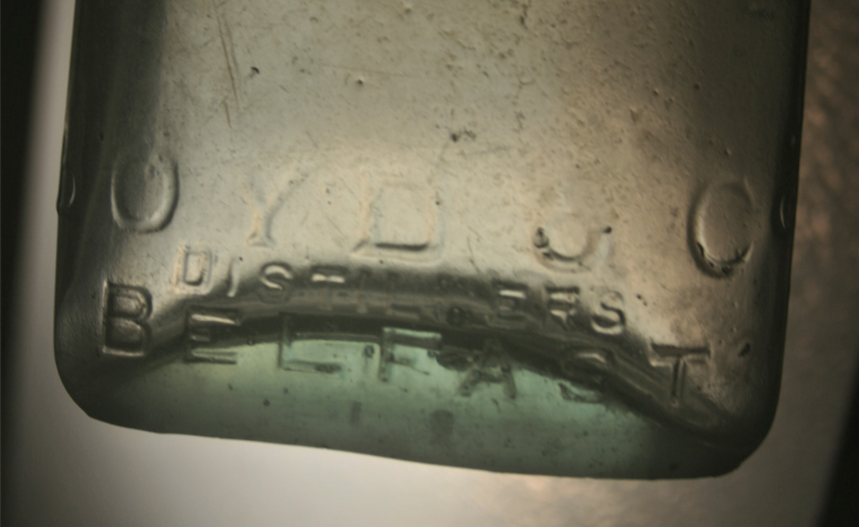
Embossed Old Innisbawn Whiskey Bottle, Boyd and Co., Belfast Imperial Pint.


INNISBAWN WHISKEY Bottle.


This green bottle is embossed as follows.

Front shoulder: OLD INNISBAWN.

Middle front: WHISKEY.

Bottom frront; BOYD and Co.
Distillers
BELFAST.

Back shoulder: IMPERIAL PINT.

Bottom: J L and G Co. or something.  Maybe John Lumb and Co.

There are a couple more marks on the bottom after J L and G Co., which I couldn't decipher for sure.  There are several sizable bubbles in the glass.


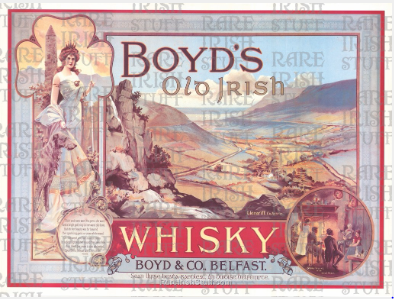
On the internet I found many examples of ads from Boyd and Co.  Below is one.


Here is some information I found.


For about a decade Samuel Wilson Boyd (1860-1932) was Chairman of The Old Bushmills Distillery Company having been the founder and owner of Boyd & Co. Distillers, Belfast. Born in Belfast, his latter years were lived at Fairbourne, Fortwilliam Park in Belfast. He was a member and 'liberal subscriber' at Fortwilliam Presbyterian Church (which closed its doors in 2018).

His first job was with the Belfast spirits firm Mitchell & Co, who also had interests in Glasgow.  Their founder, William Charles Mitchell, was born in Glasgow in 1834 but came to Belfast in the 1860s to manage the 'crowned king' of Ireland's distilleries, Dunville & Co.. Mitchell was a founder of the St Andrew's Society in Belfast.

Around 1902 Boyd bought Thomas Quinn & Co of Hill Street, which later became Boyd & Co. He was chairman of the Ulster Anti-Prohibition Council and also of the Distillers and Wholesale Wine and Spirit Merchants Association.


From that I would guess the bottle shown above would have been manufactured between 1902 and 1932.

Monday, June 6, 2022

M. N. Porter and Co., Prescription Druggists, Chicago, Embossed Old Pharmacy Bottle.


Bottle Embossed
M. N. PORTER and CO,,  PRESCRIPTION DRUGGISTS, CHICAGO

I'm trying to go through my bottle finds, get them researched and posted.  I just got started on that, and  I haven't learned anything about the history of the company yet.  With the amount of information on the  bottle, it shouldn't be difficult.  

If you can find some history on the M. N. Porter and Co., it would be much appreciated.  

---

Friday, May 27, 2022

Bottles Embossed Mexican Mustang Liniment Lyons Mfg. Co. New York.


Found Mexican Mustang Liniment Bottles
Above are two found Mexican Mustang liniment bottles.

Embossed: MEXICAN MUSTANG LINIMENT LYONS MFG. CO.  NEW YORK.

Here is just a little of what the peachridgeglass.com web site says about Mexican Mustang Liniment.

Here’s another all-healing Victorian wonder medicine, this time from the early 1850s, called Mexican Mustang Liniment. The main ingredient was rather startling: the Liniment appears to have been mostly crude petroleum oil. For Man & Beast. There is even a Trade Card (pictured below) showing a fallen lass and a horse with Mexican Mustang Liniment on its way!

And here is just one of the nice ads you will find at the same web site.

Source: peachridgeglass.com web site.
See link below.

And here is the link.

http://www.peachridgeglass.com/2012/02/mexican-mustang-linament/ 

Embossed Red Rock Co. Jacksonville, Fla Soda Bottle.


Embossed Red Rock Soda Bottle.

his bottle is embossed RED ROCK CO., JACKONSVILLE,, FLA.

It is approximately 7.5 inches tall and has a bottom diameter of about 2 inches.


Bottom of Red Rock Embossed Bottle.


According ot my research, the Jacksonville Red Rock bottling company was formed in 1938.  The brand seemed to disappear by 1950.

Mr. G. T. Dodd, a wholesale grocer, joined the bottling business, forming the company of Hagan and Dodd. They in turn founded the Red Rock Company in 1885 with Dodd as president. It was Dodd who first introduced Red Rock Ginger Ale to the wholesale grocery trade for distribution, making it well-known in the south. The ginger ale had a spicy flavor from capsicum, an ingredient derived from hot peppers. Mothers also used it to calm their family's upset stomachs and to clear stuffy noses...

Beginning in 1938 the franchises that were granted quickly established Red Rock as a leader in the 12oz field with over 200 bottlers and by 1947, was bottled in 47 states. But by 1958, there were 107 bottlers throughout the country using Red Rock Cola concentrate. Sixty-six of there were under The Red Rock franchise, while another 41 bottlers were marketing the product under their own private brand...

Here is the link for more about that.

Red Rock Cola (angelfire.com)

---

Monday, May 23, 2022

Embossed clear green Richmond, VA, BEAUFONT bottle. Beer, soda, or soda water?


Embossed BEAUFONT
Trade Mark Registered
 Bottle

Front and back reads: BEAFONT, TRADE MARK REGISTERED.

This is a mystery bottle.  I've seen it described as a beer bottle and a soda bottle.  I haven't been able to positiveley identify it, though,  From what I've read, it could be a soda water bottle.

BEAUFONT COMPANY INC., RICHMOND VA


It seems the springs in the area were first used for brewing and then could have been used for other purposes.  Below is what I found.


Home Brewing, under the guidance of Fred "Fritz" Sitterding Sr., survived the national prohibition of alcohol by producing soft drinks and bottling drinking water in pre-filtration Richmond. By 1916, Sitterding purchased the Beaufont Lithia Springs company that produced water from springs at Beaufont (approximately where the Chesterfield Towne Center is today).

Sitterding used the verdant acreage as a family gathering place and for public rental. In 1926, he renamed the water division the Beaufont, but by 1932, public water treatment lessened the demand for bottled water. Instead, a different thirst required quenching...

Source: A Sign of Pleasure - richmondmagazine.com

If you have additional information on the bottle, I'd be pleased to receive it.


Embossed Consumers Brewery Company Bottle From Rosslyn VA.


Embossed Consumers Brewing Co. Bottle.

Consumers Brewing Co. opened in 1890 and closed in 1902 it was open for 12 years. Items from breweries of this age tend to be more common and less valuable than some breweries. Early items can still be valuable as can rarer types of items. As a Pre-Prohibition Brewery, any advertising items or collectibles are likely to be valuable and desirable to collectors as they tend to be hard to find. Our information indicates that Consumers Brewing Co. was the only brewery that was located in Rosslyn, VA sometimes this means that items from a brewery will have extra value in the area it comes from because there are not other sources for local breweriana.

Source: Consumers Brewing Co. – VA 21a | Old Breweries Information | Brewer Iana Values

Another View of the Same
Consumers Brewing Co. Bottle From
Rosslyn, Va.

Consumers Brewery Company also had a bottling works in New York.

---

Thursday, May 12, 2022

STUART BOTTLING WORKS Embossed Bottle.


This bottle measures about 8.5 inches tall, and has a bottom diameter of about two inches.

I have six of these bottles.  The one shown here has nearly clear glass.  The others are more green and opaque.  All were found between Stuart and Fort Pierce, Florida.

STUART BOTTLING WORKS
embossing.


Other than the glass, its color and condition, so far I've found no differences in the six bottles.

Here is some history on the Stuart Bottling Works.


In July 1913, James Elersly Weir, Jr., purchased a pitch pine wooden building owned by Joseph A. Lucas, a real estate developer, located on an isolated dirt road (Decker Street) south of Stuart; he had it converted into a bottling plant, Stuart Bottle Works. Soft drinks were bottled, sealed with large snap off caps and distributed in Stuart, Palm City, Jensen, Salerno, Hobe Sound, even to Fort Pierce and Jupiter. Weir only remained in Stuart a few years, joining family in West Palm Beach, in the plastering business and later, an auction house.

The bottling plant building was eventually owned by Ira L. Decker, who operated a concrete manufacturing business and was used primarily for storage. In the afternoon of Feb. 6, 1933, while Decker and local firemen were battling a brush fire nearby, the building caught fire. The wooden structure quickly went up in flames making it impossible for Ira to retrieve equipment, vehicles or machinery.

At least two bottles from the plant survive, clearly marked Stuart Bottling Works, one of which can be seen at the Stuart Heritage Museum...


Monday, March 28, 2022

J. R. Watkins Bottle.


J. R. Watkins Co. Bottle.
Probably 1920s or 1930s


The J. R. Watkins Company began in 1868 as a small home-based business in Plainview, Minnesota, founded by entrepreneur Joseph Ray Watkins.

Watkins distributed many different types of household products including cleaning products, food extracts and  flavorings, cosmetics,  home remedies, and other products.  (They did not actually make the bottles in which these products were contained.)   As business increased, in 1885 the company operations were moved from Plainview to Winona, Minnesota.

The very first bottles sold are assumed to date as far back as 1868, but I doubt that the very earliest containers were actually embossed with the “Watkins” name, but would have likely been “generic” hand blown bottles with a paper label affixed to indicate contents. (If anyone has more information on this, please contact me!)

By the very early 1870s, as business continued to expand,  it is likely that bottles were being embossed with Watkins or “J. R. Watkins Co.”   The earliest versions of the Watkins bottles were made in aqua glass, were handmade (with a tooled lip) and have the lip fashioned for a cork closure.  Later versions (I don’t know the exact year, but probably by the 1920s or early 1930s) have a threaded-style lip for a screw-on lid.

There are probably hundreds of slightly different Watkins bottle mold variants in existence that have been used over the last 140 years, with a variety of differences in font style, exact wording arrangement, size and shape of the bottle, and I imagine it would be a monumental task to find just one example of every single one of them.

Watkins bottle in aqua glass, tooled lip, probably dating from the 1890s to 1910s, unknown glass manufacturer.
Light aqua glass WATKINS medicine bottle, handblown with a tooled lip.  This type probably dates from sometime in the 1890s to 1910s. The base bears the mold number “64”.  The maker is unidentified as there is no glass manufacturer mark to be found.

Many of the bottles from the 1920s-1940s are quite common, and are usually in clear glass and rectangular in shape.  Sometimes the embossed company name is in a cursive font, and sometimes in a plain “block style lettering”. White milkglass salve or “ointment jars” were also sold.

Here is the link.

Friday, March 25, 2022

Seminole Milk Company, Jacksonville Fla. Half Pint Bottle. Circa 1927.


Newly Dug Seminole Milk Company Bottle
Jacksonville, FL.  Circa 1927.


This bottle reads as follows. 

HALF PINT
LIQUID
PROPERTY OF
AND CONTAINS
MILK OR CREAM
PASTEURIZED AND BOTTLED
BY
SEMINOLE MILK COMPANY
JACKSONVILLE, FLA.

 
It was not easy to get a good photo of this bottle.  Maybe I can get a better photo.  Even when the bottle is well lit and well positioned, the embossing has so many words that with the curvature of the bottle you can't capture all the text in a single photo.

The bottle is in great shape.  No cracks or chips.  It also has some great grip bumps around the neck.

The maker's mark is a 5/W, which indicates Winslow Glass Works, circa 1912 - 1927.  I read elsewhere that the Seminole Milk Company operated 1926 - 1936.  I'd place this bottle around 1927.  Great piece of Florida dairy history.


Wednesday, March 9, 2022

Brown Hicks' Capudine Bottle.


Hicks Capudine Bottle.


Henry Hicks had two drug stores in Raleigh, North Carolina.  He invented Capudine around 1900.  It became very popular, and he became wealthy.

Henry Hicks’ mansion still stands on Hillsboro Street, though, sadly, its grandiose porticoes have been long lost.

Interestingly, just as Hicks was achieving wealth and renown, the American Medical Association commenced a crackdown on patent cure-all medicines.

The Association analyzed Hicks’ Capudine and found the concoction to be “a brown, rather syrupy liquid, slightly alkaline to litmus, with an aromatic odor and a salty taste. Besides 8 percent alcohol, Capudine was found to contain sugar, aromatics, chlorides, caffeine, antipyrin and salicylates.” Yikes!

The AMA declared that Hicks’ Capudine was “a barefaced attempt to exploit both the medical profession and the public, [and that] this nostrum is probably preeminent in the annals of the ‘patent medicine’ business.”

Nonetheless, although Mr. Hicks died in 1940, the Capudine Chemical Co. continued to manufacture ‘medicinal cures’ in Raleigh into the early 1960s.


Source: Goodnight Raleigh | a look at the art, architecture, history, and people of the city at night

---


Sunday, February 20, 2022

Aqua Blown Adolphus Busch Manufacturing Co. Beer Bottle. A. B. G. M. Co.


Blown Aqua Adolphus Busch Glass Manufacturing Company Bottle.


This bottle was made prior to 1916.  It shows a lot of bubbles and has an applied top with rounded lower ring.  You can see the markings on the bottom.

For a great site on Adolphus Busch bottles, here is a link.

Sunday, February 13, 2022

Nov. 16, 1915 Patent Date Coca Cola Bottle With Script Bottom.


Below is a newly found Nov. 16, 1915 Coca Cola bottle.


Below is a little of the history of the bottle as presented on the MOAS web site.

When Coca-Cola was faced with the challenge of other competitors, bottlers agreed upon having a bottle that would stand out to the public. Benjamin Thomas and his associates set a deadline for bottling companies to come up with a distinct, marketable bottle for the ever-so-popular soft drink.

Among the eight to ten participants was the Root Glass Company of Terre Haute, Indiana. Members of the Root Glass Co., Chapman J. Root, William Root, Alexander Samuelsson, Earl Dean, and Clyde Edwards, worked endless hours in complete secrecy, manufacturing what they hoped would be the new, unmistakable bottle for the beloved carbonated beverage. They created a bottle in which they nicknamed the “hobbleskirt,” due to the resemblance of the skirt-style in 1910. Their historic bottle was derived from the shape of a cocoa bean, with an elongated shaped and distinct ribs. Once the bottle was developed, Root Glass Company put forth a patent under Samuelsson’s name. The patent was granted on November 16, 1915. This date was later included on the final design of the bottle.

In the early 1916, a committee composed of bottlers and Company officials met to hopefully decide on the design of their bottle. Without a doubt, the Root version was a clear winner. The Coca-Cola Company and the Root Glass Company entered an agreement in which the bottle was to be made throughout six factories in the United States. The contract also called for the bottles to be colored in “German Green,” which was later changed to “Georgia Green.” The weight of the bottle was to be no less than 14.5 ounces and was filled with 6.5 ounces of Coca-Cola, which means that the bottle weighed more than a pound!...


And here is the link for more about that.


The Root Family donated a large amount of Coca-Cola memorabilia to the MOAS Museum, which is in Daytona.

I've seen similar bottles listed online for nearly $200, however that, being the top of the range, could be an unrealistic price.  The found bottle has defects and is in far from perfect condition, but in my opinion should still be worth a few bucks.

Monday, August 16, 2021

Embossed Hayner Whiskey Distillery Back Bar Bottle.


Embossed Back Bar Hayner Whiskey Bottle.

This embossed Hayner Whiskey bottle was found on the Treasure Coast.  It is a pre-prohibition bottle, meaning that it dates to pre-1920.  It is just over eleven inches tall.   You can see a bubble in the glass below the R in TROY.

There was a paper label between "HAYNER WHISKEY" and "DISTILLARY"

The bottom provides a lot of information.

Bottom of Same Hayner Whiskey Bottle.

The patent date is Nov. 20, 1897.

See Bottle Pickers (antiquebottlepickers.com)


Monday, August 9, 2021

E R Durkee and Co. Salad Dressing Bottle.

Here is a bottle embossed E. R. Durkee and Co. Salad Dressing. 

E R DURKEE and CO SALAD DRESSING BOTTLE.

It is a blown bottle with some nice bubbles in the glass.  

E R Durkee and CO Salad Dressing Bottle.

The glass maker marks on the bottom are also interesting.   The bottle has the patent date clearly written out as April 17 1877.

Patent Date On Durkee Bottle.

Eugene R. Durkee – making spices and extracts in his basement at home – at 1850, and we have seen an advertisement for the firm as early as 1851 – the year given by most sources. The early ad noted that E.R. Durkee (no “& Co.”) was a “Wholesale and Retail Dealer in Drugs, Medicines, Perfumery, Brushes, Fancy Articles, Glassware, Congress Water, Leeches, Cigars, Pure Wines, Liquors, Oils, Camphene, Burning Fluid &c.” in Buffalo, New York. The only products specifically linked to his name were Durkee’s Venetian Liquid Hair Dye, Durkee’s Vermifuge, and Durkee’s Baking Powder (Matt’s Collectibles 2014) (Figure 1). Durkee developed his salad dressing during this period, probably in 1857, and won awards for it (Kovel 2010; Museum of the City of New York 1999:71)...

Here is the link for that information and much more.

ERDurkee&Co.pdf (sha.org)

Embossed Dr. Shoop's Family Medicines Bottle.

 Written by the TreasureGuide for the exclusive use of the Treasure Beaches Report.


Green Deeply Paneled Bottle Embossed DR. SHOOP'S FAMILY MEDICINES, RACINE, WIS.

The bottle is a deeper green than the picture shows and has deep panels and embossing.  It is about 6,25 inches high and 2.5 inches wide and deep.

Dr. Shoop's Medicine Bottle Showing Large Bubbles in the Glass.


There is no maker's mark on the bottom.

Bottom of Dr. Shoop's Medicines Bottle.


I was fortunate to find a lot of information on Dr. Shoop. Here is one paragraph from a much larger article on Dr. Shoop.

Dr. Shoop opened a medical practice in 1883 and by 1890 established a line of cure - all patent medicines which were sold door to door by agents. Dr. Shoop’s Family Medicine Co. was incorporated June 30, 1891, (Capital, $20,000) with Shoop, Jackson I. Case and Charles A. Corbitt as officers. Unable to find suitably large quarters Shoop had plans drawn for a new plant. A lot was purchased and the first three stories of the Shoop Building were completed in 1893, with three additional stories added in 1899 making it the tallest commercial building in Racine.

Here is the link if you want to learn more about this local bottle find.

Racine Post: Celebrating 175 years: Dr. Shoop, Racine's creator of 'nerve tonic'


Monday, July 19, 2021

McCreary Drug Company Bottle. West Palm Beach, Fla.


This is a larger Drug Company bottle.  It measures about 7.5 inches tall and 2.5 inches wide.

It has one big chip on the lip.


The crescent moon mark on the bottle is from an unidentified manufacturer.  Most bottles that bear this mark seem to be pharmacy or drug co. bottles.


Old Showing McCreary's Location.
Source: FloridaMemory.com

y

Thursday, July 8, 2021

Cobalt Blue Embossed Larvex Poison Bottle.

Embossed LARVEX Bottle.

 Larvex Corporation was a company which manufactured Spraying Larvex, a pest control product used in moth proofing woolen fabrics. The firm was acquired by Zonite Products Corporation in October 1926. Zonite added Rinsing Larvex to its line of products after the takeover was finalized. The pesticides were also referred to as Larvex liquid and cake.

Larvex Corporation continued as a subsidiary of Zonite Products Corporation until December 31, 1936. On this date Zonite Products Corporation informed the New York Stock Exchange that it was dissolving its six subsidiaries.


Bottom of the Larvex Bottle Showing
Maryland Glass Company Mark.


The circle M indicates the bottle was manufactured by the Maryland Glass Company.

Maryland Glass was acquired by the Dorsey Corporation in 1968, and I believe that the “M” mark was used for a time thereafter, but eventually discontinued sometime in the  1970s.

Wednesday, July 7, 2021

LAXOL Bottle. Cobalt Blue.

 Cobalt Blue LAXOL bottle.


It seems the cobalt blue color is most common.  Some other colors are know and can bring high prices.


Friday, June 11, 2021

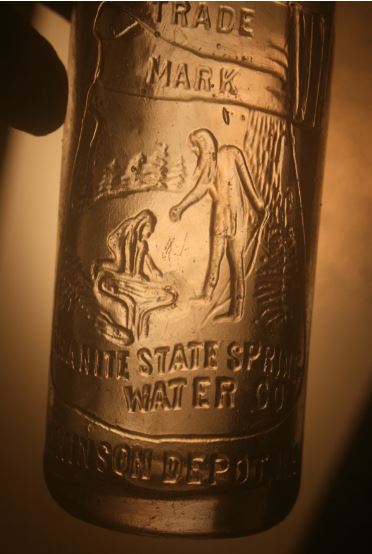
Granite State Spring Water Company Bottle.

Embossed Granite State
Spring Water Company Bottle.

 Embossed: TRADE MARK GRANITE STATE SPRING WATER CO.ATKINSON DEPOT, N.H. 

A bottle of this type was featured in the Sept. 2010 Antique Bottle and Glass Collector Magazine (pg. 29).

It dates between 1895 – 1905.

Measures 9” tall and 2-1/8” diameter.

It shows two Native Americans.

1895 - 1905 Granite State
Spring Water Company Bottle.


The company was located in Plaistow, N. H.

When the company went bankrupt, about 1938, it was purchased by Leroy’s Beverages, Inc. of Newburyport, Massachusetts, which later produced 7-UP.

Saturday, May 1, 2021

Small Brown Luyties Pharmacy Co. Bottle. St. Louis.


Small Luyties Pharmacy Bottle.


The Luyties Pharmacy bottle is just 2.5 inches tall, with a .75 by .75 inch square base. 

Here is what I found on Luyties.

His earliest knowledge of and training in business came to him through the Luyties Homeopathic Pharmacy Company, a business which was established in 1853 by his father, Dr. Luyties having been one of the earliest representatives of the school of homeopathy in the middle west, and in connection with his practice he established a pharmacy in order to supply homeopathic remedies to the trade.

Thoroughly acquainting himself with the business, Herman C. G. Luyties won promotion until he became vice president of the company and so continued until 1907, when he disposed of his interests...

Listerine Pharmacal Company embossed bottles.

  One type of common bottle find is the Listerine bottle.  These examples are not screw tops but neither are they older blown bottles.  They...